Field Notes · August 2026 · Observation
AI doesn't recommend the best restaurant. It recommends the most validated one.
By Margaret Arias · The Food Architect
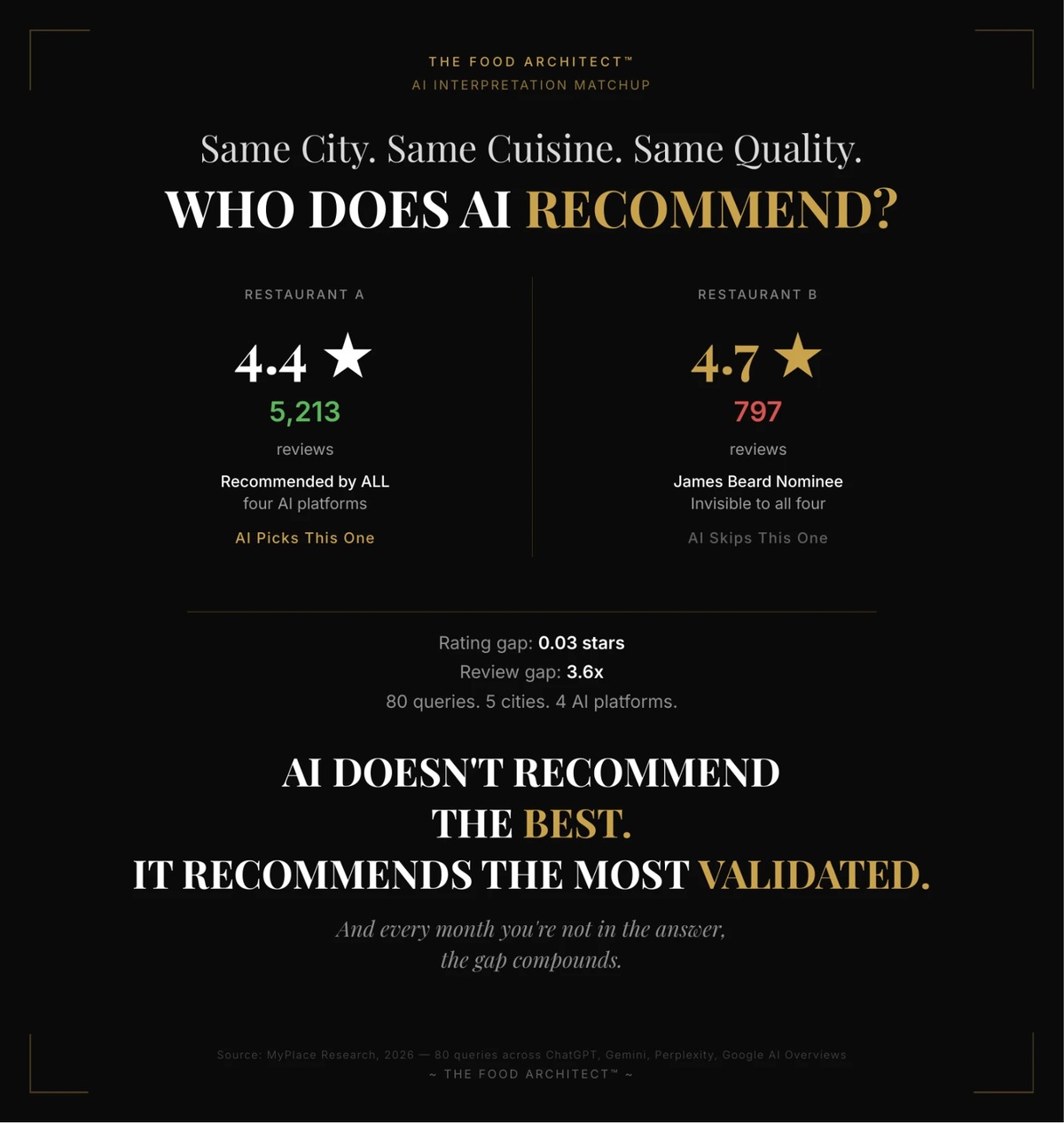
Two restaurants, same city, same price band. One holds 4.4 stars across more than 5,000 reviews. The other holds 4.7 stars across roughly 800 reviews and national award recognition.
Both are real. Neither is named, and the figures are rounded — the pattern is the point, not the businesses.
Ask an assistant where to eat and the first one gets named. Every time. Not because it is better. Because it is easier to be confident about.
Confidence, not quality.
A recommendation engine is not making an aesthetic judgment. It is managing risk. It reaches for the option it can describe without hedging — the one with enough repeated, consistent, machine-readable language behind it that a wrong answer is unlikely.
Volume of validation is a shortcut to that confidence. So is consistency of language. A restaurant described the same way across its site, its listings, its menu, and its reviews is a restaurant the machine can name out loud. A restaurant described four different ways is a restaurant it quietly skips.
That is the injustice worth naming plainly: the operator doing the better work is often the one with the thinner paper trail.
What actually closes the gap.
Not more reviews. You cannot out-volume a chain location, and chasing that number is the wrong game. What you can do is make the evidence you already have unambiguous.
Three moves, in order. First, one sentence that says what you are — used identically everywhere a machine can read it. Second, menu and listing language specific enough that it cannot be confused with the category median. Third, guest language: the four sentences a happy guest can write that turn a good night into evidence a machine can cite.
None of that is marketing. It is translation. The room is already good; the description of the room is what is failing.
Start by looking.
Before changing a word, find out what the machines currently say you are. A Guest Read shows you the interpretation as it stands today — the concept, the audience, the occasions you are eligible for, and the ones you have quietly been removed from.
Most operators discover the gap is not their food. It is the vocabulary standing between the food and the recommendation.
Commission a reading
Every observation started as a reading.
The Guest Read is the first act of the study. It shows you how AI currently interprets your restaurant — before anyone edits a word.
Related: The Guest Review Guide · The Operator Vocabulary Library · The Interpretation Gap